
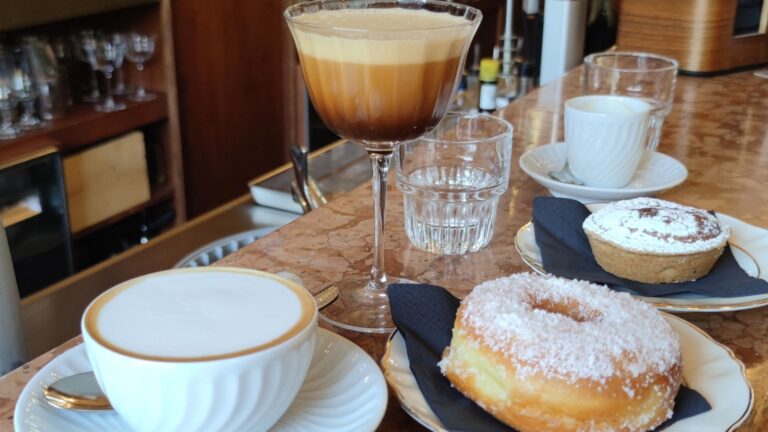
When people think of Florence, they usually picture the Uffizi Gallery or the magnificent Duomo. However, the city is also home to several historic cafés that have welcomed artists, writers, and intellectuals for more than a century.
One of the most fascinating is Giubbe Rosse, located in Piazza della Repubblica. In the early 20th century, it became the meeting place for Futurist artists and writers, who gathered here to discuss revolutionary ideas that would transform Italian art and literature.
My daughter recently studied the Futurist movement in high school and became fascinated by the idea that young artists once gathered in this very café to debate the future of art and society. She told me, “I’d love to visit the place where all those discussions happened.”
So, after many years, we decided to return to Giubbe Rosse.
A City Where History Becomes Real

One of the wonderful things about living in Florence is that history isn’t just something you read about in textbooks.
Places like the Uffizi Gallery, Piazza della Signoria, and Giubbe Rosse are all within walking distance.
Being able to visit the very places where historical events happened or where famous artists once gathered makes history feel much more real. I believe this is one of the greatest advantages of raising children in Florence.
Returning After Many Years
We visited Giubbe Rosse several times when my daughter was little, but over the years we naturally found ourselves spending more time at other historic cafés in the city.
Returning after such a long time, I was happy to find that the café still had its calm and elegant atmosphere.
Although it sits in the heart of busy Piazza della Repubblica, it felt noticeably less crowded than some of Florence’s other famous cafés, making it a pleasant place to relax for a while.
Surprisingly Large Breakfast Pastries
The first thing that caught my attention was the size of the breakfast pastries.
Compared with the other historic cafés around the square, the croissants here were noticeably larger and more filling.
The cappuccino and espresso were every bit as good as those served elsewhere, offering the authentic Italian café experience that Florence is famous for.
Comparing Tuscany’s Traditional Budino di Riso
Every time we visit a Florentine café, my daughter looks for one particular pastry: Budino di Riso.
This traditional Tuscan pastry consists of a crisp tart shell filled with creamy rice cooked in milk and enriched with custard before being baked.
Although every café serves the same classic dessert, each version has its own personality.
The Budino di Riso at Giubbe Rosse had a wonderfully simple, traditional flavor that felt homemade.
By contrast, the version at Paszkowski had a delicate hint of lemon, giving it a lighter and more refined taste.
My daughter enjoys both versions, but she described the difference perfectly:
“Giubbe Rosse tastes traditional and comforting, while Paszkowski feels a little more elegant.”
Trying the same Tuscan specialty at different cafés is one of the most enjoyable ways to discover Florence’s culinary traditions.
Which Historic Café Should You Choose?
Each of Florence’s historic cafés has its own unique character.
☕ Giubbe Rosse (Piazza della Repubblica)
- Perfect for lovers of literature and art history
- Usually less crowded than neighboring cafés
- A historic meeting place of the Futurist movement
- Large breakfast pastries
☕ Paszkowski (Piazza della Repubblica)
- Popular with local Florentines
- Relaxed atmosphere
- Comfortable outdoor seating
- My daughter’s favorite café
☕ Gilli (Piazza della Repubblica)
- Elegant and refined
- Perfect for a special coffee break
- One of Florence’s most beautiful historic cafés
☕ Rivoire (Piazza della Signoria)
- A paradise for chocolate lovers
- Famous for its chocolate-filled croissants and hot chocolate
☕ Caffè Giacosa (Near Via de’ Tornabuoni)
- Luxurious interior
- Ideal for an elegant afternoon break
- Excellent cream-filled croissants
My Personal Favorites
If I’m visiting with my daughter, we usually end up at Paszkowski, simply because she loves its relaxed atmosphere.
When I’m looking for a more elegant experience, I usually choose Gilli or Caffè Giacosa.
And whenever I’m craving chocolate, Rivoire is always my first choice.
Each café has its own personality, so choosing one often depends on my mood that day.
Enjoy More Than Just Coffee
Florence offers countless wonderful places to enjoy an espresso or cappuccino.
But what makes these historic cafés truly special is something beyond the coffee itself.
As you sit there, it’s easy to imagine that, more than a hundred years ago, artists, writers, and intellectuals were sitting at nearby tables, discussing ideas that would shape the future of Italian culture.
That feeling of sharing a space with history is something uniquely Florentine—and one of the reasons I never grow tired of visiting the city’s historic cafés.