High School Graduation, but the Studying Isn’t Over Yet
My daughter graduated from high school in Italy this summer and will begin studying at the Conservatorio di Firenze (Florence Conservatory) this October.
After successfully completing her final high school examinations, we thought she would finally be able to enjoy a well-deserved break.
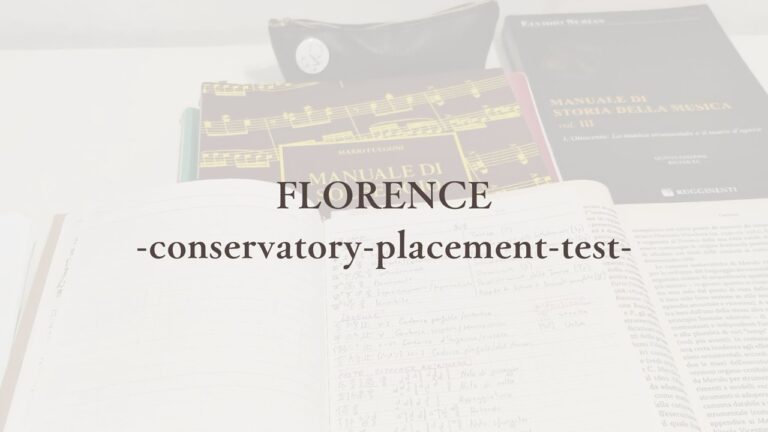
Instead, she has already started preparing for another challenge—the placement tests held in September before the academic year officially begins.
Admission to an Italian Conservatory
One aspect of the Italian conservatory system that many international students may find interesting is how admission works.
Students first take a performance entrance examination, and those who pass are admitted to the conservatory.
After admission, however, they are required to take placement tests in several academic music subjects before classes begin.
Placement Tests Before Enrollment
The subjects vary slightly from one conservatory to another, but at the Florence Conservatory my daughter will be tested in:
- Harmony
- Ear training
- Rhythm
- Basic musical analysis
- Music history
- Piano
These are placement tests rather than entrance examinations.
Students who do not reach the required level are not denied admission. Instead, they simply take additional classes after enrollment to strengthen the areas where they need more preparation.
Some Students Are Exempt
Italy has specialized music high schools (Liceo Musicale) as well as Pre-Academic Programs offered by conservatories.
Students who have already completed these courses and passed the required examinations may be exempt from some or all of the placement tests.
My daughter deliberately chose to attend a high school specializing in economics and law rather than a music high school.
As a result, she has been studying music theory independently in preparation for the September tests.
Another Summer of Studying
Even if she does not pass every placement test, she will still begin her conservatory studies in October.
The only difference is that she would need to attend additional foundation classes during her first year.
Still, she hopes to pass as many subjects as possible so that she can focus on her major once classes begin.
So, instead of taking a long summer break after graduation, she has gone back to studying once again.
One story made her feel a little more relaxed.
Apparently, the piano professor is so popular that some students jokingly say,
“I’m actually glad I didn’t pass the piano placement test—I got to study with such a wonderful teacher!”
Hearing that made the upcoming exams seem much less intimidating.
A Flexible Educational Approach
Personally, I appreciate this educational system.
Rather than expecting every student to have exactly the same academic background before enrollment, the conservatory evaluates each student’s musical foundation and provides additional instruction where it is needed.
This allows students to continue developing their performance skills while strengthening subjects such as harmony, music theory, piano, and music history throughout their studies.
There is also a well-known story that the great Italian composer Giuseppe Verdi was rejected by the Milan Conservatory when he was a young man. Although historians continue to debate the details of that story, it is often mentioned when discussing Italian music education.
Since I am only familiar with the Italian conservatory system, I cannot compare it with conservatories in other countries. However, I personally appreciate an approach that supports talented performers while giving them the opportunity to build a stronger academic foundation after enrollment.
For me, this flexibility is one of the most interesting aspects of studying music in Italy.